In the ever-evolving digital landscape, the importance of strategy cannot be overstated. At NetBramha, we recognize that a well-defined strategy is the compass that guides your business towards success.
In a world of rapid change and fierce competition, businesses need strategies that are not just robust but also adaptable. Our Strategic Services offer precisely that. We combine the wisdom of traditional strategic thinking with the agility demanded by today’s digital landscape.
Our strategies are not set in stone but are flexible roadmaps that evolve with your business and market dynamics. This adaptability ensures that your business stays ahead of the curve.
At NetBramha, we understand that every business has its unique objectives. Our Strategic Services start with a deep dive into your business, mission, and vision. We believe that a one-size-fits-all approach to strategy is insufficient.
Our team of seasoned strategists collaborates closely with you to comprehend your specific goals. We then craft a tailor-made strategy that aligns perfectly with your business’s long-term mission and vision.
In today’s data-rich environment, strategic thinking without data is like navigating uncharted waters blindfolded. Our Strategic Services leverage the power of data analytics to inform your strategic decisions.
By analyzing market trends, customer behavior, and industry insights, we ensure that your strategy is grounded in reality. This data-driven approach empowers you to make informed choices that maximize the impact of your strategy.
A well-crafted strategy is not just a roadmap; it’s a compass that keeps your business on the right track. Our Strategic Services provide you with a clear path to success, outlining the steps, milestones, and checkpoints along the way.
With a well-defined strategy in place, you can confidently tackle challenges and seize opportunities, knowing that every action you take is aligned with your long-term vision.
At NetBramha, we don’t believe in delivering strategies in isolation. We consider ourselves an extension of your team, working closely with your business at every stage of the strategy implementation.
Our collaborative approach ensures that your team is equipped with the knowledge and resources needed to execute the strategy effectively. We don’t just create strategies; we empower your team to bring them to life.
Our Strategic Services go beyond traditional strategizing. We offer a dynamic, data-driven, and adaptable approach that is tailor-made for your business’s unique needs.
In a digital landscape where adaptability and informed decision-making are paramount, a well-crafted strategy becomes your most valuable asset. Allow us to be your strategic partner, guiding your business towards sustainable growth and long-term success.
Join us on this journey of strategic excellence, where insights lead to action, data drives decisions, and strategies pave the way to your business’s triumphant future.
At NetBramha, we are unwavering in our commitment to unlocking your business’s full potential through strategic thinking that charts a path to success. Let’s embark on this transformative journey together.
Design Thinking
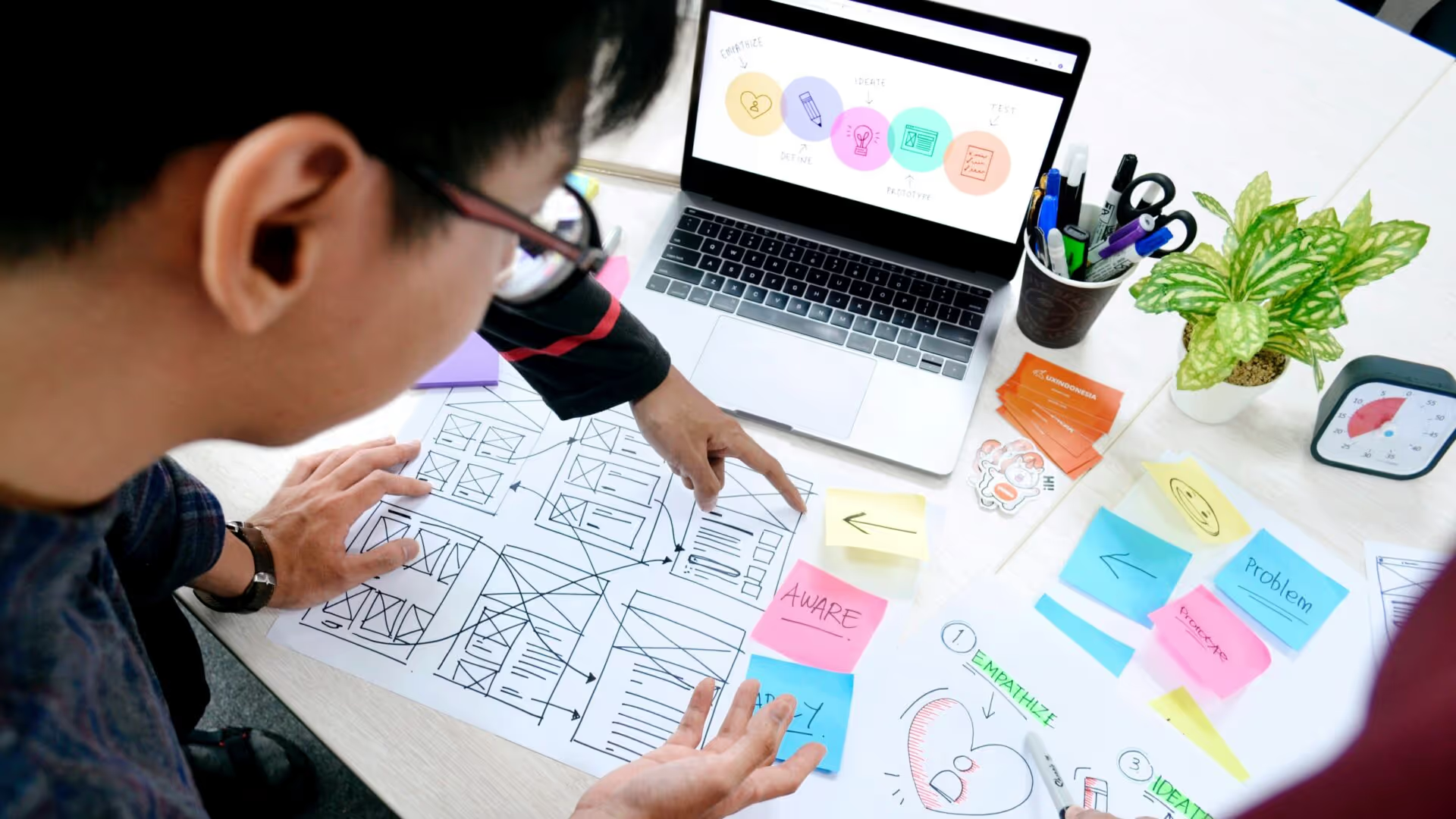
Contrary to its nomenclature, design thinking is not a tool limited to designers, but extends to all innovators, thinkers, creators, & solution-providers. Design Thinking refers to the iterative (& non-linear) process of understanding users, challenging assumptions, redefining problems, & creating better solutions; all of which are done to prototype & test faster. Empathy is of key importance here as all design decisions revolve around users. Another important factor is experimentation, in the face of known/unknown/ill-defined problem statements.
Product Roadmap
A product roadmap is the guiding strategic document that clearly defines the plan for executing the UX/product strategy. Much akin to its name, a product roadmap maps out the vision & direction of the product across time, along with short & long-term goals, priorities, & progress of the plan. The main goal of a product roadmap is to define the vision & design strategy, provide a clear guideline for execution of the design strategy, align internal stakeholders, facilitate options & scenario planning, & enable communication with external stakeholders.
Growth Strategy
Through growth strategy, your business can unlock doors to consistent growth & expansion by overcoming current & future challenges. This is done by finding the right product/market fit, innovating new products powered by robust user insights, & providing superior user experience, better engagement, & high product stickiness.
Service Design
Through service design we create sustainable & optimal solutions for solution/service providers. Service design is how we organize & realign an organization’s resources – the people, the process, & the properties to enhance the employee experience that indirectly improves the end user experience. In service design, much like user experience design, several moving components should be aligned & integrated correctly to ensure a smooth, seamless course of action internally across large enterprises.


A business strategy consultant tells you where to compete. UX and product strategy tells you how the product itself needs to behave to win there — which user problems to solve first, how the experience should be structured across flows, and what the product roadmap should prioritize and in what order.
The difference matters because a deck full of market positioning doesn't help a product team on Monday morning. NetBramha's strategy work is built to connect directly to design execution, run by the same team, which is why it sits between Research and Design in every engagement rather than floating separately above them.
Most internal roadmaps are built from a mix of stakeholder priorities, engineering constraints, and whatever the loudest customer said last quarter. That's not a strategy, it's a negotiated list.
An external UX strategy engagement pressure-tests that list against actual user behavior and business outcomes, not internal opinions. It doesn't replace the team's judgment — it gives that judgment something real to work with. NetBramha has run this kind of engagement for product teams across India, the US, the UK, and the Middle East, and the pattern is consistent: the roadmap usually needs restructuring more than it needs adding to.
Earlier than most teams bring it in. The instinct is to call in strategy when something is clearly broken, but by then the cost of fixing structural decisions is already high. The highest-leverage moment is before the product direction is locked, when there's still room to reframe the problem rather than just optimize the current approach.
That said, it's also worth running when a mature product hits a growth ceiling it can't explain. EMAAR's $1Bn+ digital property platform and Razorpay's 20% conversion lift both came from strategy work on products that were already live, already used, but hadn't yet been examined against what users were actually trying to accomplish.
Research produces observations. Strategy converts them into priorities. The step between "users are confused at checkout" and "here is the revised flow, the rationale behind it, and where it sits in the roadmap" is where most agencies leave a gap — they hand over findings and step back.
NetBramha doesn't separate those stages. The researchers feeding insights in are working alongside the strategists building the product roadmap and growth strategy from them. What comes out is a set of decisions with evidence behind them, not a research report and a strategy deck that were written by different people who never spoke to each other.
They're not interchangeable, and the right one depends on where the problem sits. Design thinking is for reframing a problem that isn't well-defined yet. A product roadmap is for sequencing decisions once the direction is clear. Growth strategy is for products that need to scale their impact, not just their features. Service design is for organizations where the internal process is creating friction in the user experience.
Most engagements end up touching more than one of these, because product problems rarely sit neatly in a single category. Get in touch and we'll tell you which combination actually fits what you're dealing with.